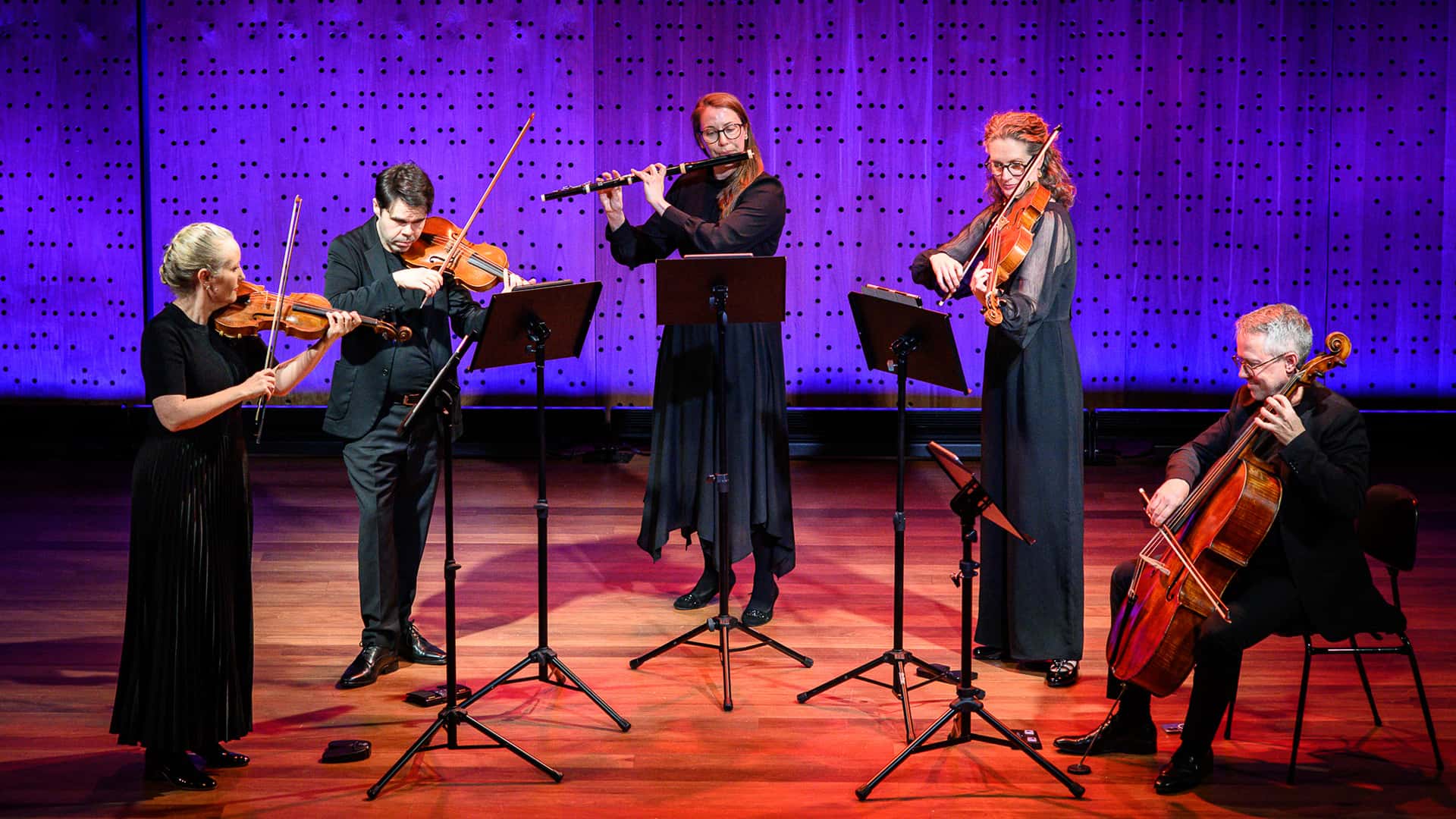
One of the wonderful concommitants of contemporary Baroque or Classical performances in Sydney is that they are often capable of making you think you're hearing familiar masterpieces for the first time. So it was with Skye McIntosh’s ensemble, containing as it does players who regularly perform with another excellent Sydney institution dedicated to historical performance practice, Pinchgut Opera’s Orchestra of the Antipodes – Matthew Greco as second violin, Karina Schmitz, viola, and Daniel Yeadon, cello.
As an adolescent I listened a lot to the Amadeus Quartet’s recording of Schubert’s A minor quartet. I loved its uneasy shifting between melancholy and resignation, interrupted only occasionally with raging against the dying of the light. Often it inhabits the emotional world of Schubert’s song cycle Die schöne Müllerin, and seems even to quote from it at times – the second episode in the finale is very like the song “Trockene Blumen” – and, like the cycle, the whole work hovers tearfully between minor and major. The Australian Haydn Ensemble, in string quartet mode, captured this perfectly. Nothing overplayed, they invited the audience into Schubert’s interior world with their exquisite, honest playing, naked of vibrato and yet subtly expressive. The biggest revelation to me was what Daniel Yeadon did with the so-called minuet. His question in the lowest register of the cello, with which the movement opens, became the door into the most profound moment in the entire quartet, where all the unasked questions of the opening movement are answered. The answer is not one you want to know.
Both the first and last movements of this quartet “finish” with strong cadences, after which Schubert tacks on reflective codas. The ensemble intensified the effect of the silence which followed these cadences, and indeed other dramatic moments in both Schubert’s and Haydn’s works, by holding dynamic stillness on stage. They also used this stillness as a frame for the music, delaying applause by remaining completely motionless at the end of pieces, as if to say, the sound may have finished, but the music still resonates.
In this concert, Haydn’s music book-ended both Schubert’s quartet and the achingly chromatic Fantasia by Purcell which began the second half of the concert. The concert opened with his op 76 no. 6 in Eb, a work which Charles Burney described as “not the production of a sublime genius … but of one who had expended none of his fire before” (as quoted by Richard Bratby in his erudite and entertaining program notes). All the players, but especially Matthew Greco and Karina Schmitz, infectiously enjoyed the endless series of unexpected quirks that this extraordinary piece displays.
The first movement is a set of variations which obeys none of the conventions for this form. There are no virtuosic diminutions, and no minore variation – rather, each variation examines different harmonic possibilities of the theme. It is followed by a movement entitled Fantasia, which reminded me of the Eb major “Sonata quasi una fantasia” op 27 no 2 by Beethoven (the companion piece to the Moonlight sonata, which is also so titled) composed a couple of years later. Then comes a movement which is more like a Beethoven scherzo than a minuet, which has a particularly perverse trio section – just a scale, both up and down in one instrument after another, while the other instruments comment on it as if to say “Really? Haven’t you anything else to say?” And though the last movement is in a consistent ¾ metre, it is so rhythmically wild that just as you think you are getting hold of the rhythm you lose your way again. Skye McIntosh’s quartet played this work with the authentic enthusiasm of a radically new discovery.
The concert finished with an arrangement of Haydn’s 96th symphony, to which the label “Miracle” became attached. Apparently, at the performance of one of his symphonies in 1795, when Haydn came on stage to direct from the keyboard, many of the audience left their seats and swarmed down to get a glimpse of the great composer. At this point a chandelier fell from the ceiling, onto nothing but recently vacated stalls, and the fact that no-one was hit by it was called a miracle. (It wasn’t this particular symphony, but never mind…)
Haydn’s number one London fan, the impresario Salomon who in the 1790s masterminded Haydn’s two trips to London for multiple performances of his music, made arrangements of all his “London” Symphonies for string quartet plus flute, so that people could get to know them at home before hearing the real thing in concert – rather as we do with digital recordings nowadays. For the performance of the “Miracle” symphony the quartet was joined by the brilliant Baroque flautist, Mikaela Oberg.
It was incredible the difference that adding one flute to the ensemble made. It was also a great opportunity to hear more of Oberg than when she plays with the Orchestra of the Antipodes in their operatic performances, where she might get to play in half a dozen arias at best. Superlatives run out for her playing – it is simply perfect, in purity of tone, in the subtlest changes of colour, in the change between woodwind solos and tutti passages. When she played forte in unison passages the ensemble created the illusion of a full orchestral tutti while still sounding like a chamber group. It was memerising stuff.
Haydn is one of those composers who everyone admires but is rarely on people’s desert island list. His music follows C. P. E. Bach’s advice to performers to “hardly arouse one passion but replace it with another”, a trait which I think particularly attracted his English audience; yet this trait can also make his music strangely elusive. We are so lucky to have in our midst a group of musicians like those of the Australian Haydn Ensemble, who really get Haydn.
Event details
Australia Haydn Ensemble presents
Haydn's Miracle
Artistic director Skye McIntosh
Venue: The Neilson | Pier 2 / 3, Dawes Point, Sydney NSW
Dates: 21 – 24 August 2025
Bookings: www.australianhaydn.com.au